


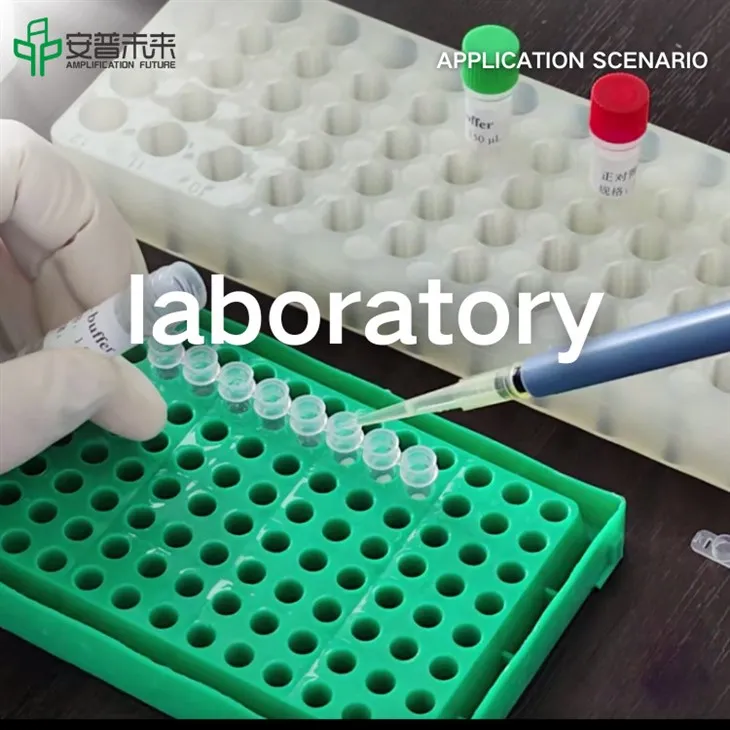
The MIRA DNA Isothermal Rapid Amplification Kit utilizes advanced nucleic acid amplification technology at both room temperature and a constant temperature (typically 39ºC to 42ºC). With the assistance of auxiliary proteins and single-strand binding proteins, recombinase and primers form a complex that searches for and binds to the target homology domain. This results in the formation of a D-loop region at the homologous site, initiating strand exchange. As recombinase dissociates from the complex, the polymerase binds to the 3' end of the primer, beginning the chain extension process. Additionally, by leveraging exonuclease activity, the kit uses specific molecular probes designed for the template, allowing for real-time monitoring of the target fragment amplification process via fluorescence detection equipment.
【Features】
High Sensitivity
The kit offers outstanding sensitivity and specificity for nucleic acid amplification.
Fast Reaction Time
The amplification process takes only 20 minutes, providing rapid results.
Convenient Storage & Handling
The reaction components are in dry powder form, easy to store and handle.
Wide Compatibility
Compatible with various fluorescence quantitative PCR instruments, constant temperature fluorescence amplification systems.
【Primer Design】
For optimal performance, primers should be 30-35 bp in length. Short primers may reduce amplification speed and detection sensitivity. Primer designs should avoid secondary structures that could impede amplification. The recommended amplicon length is 150-300 bp.
【Fluorescent Probe Design】
The fluorescent probe should not overlap with the specific primer recognition site. It should be 46-52 nt in length, avoiding palindromic sequences, internal secondary structures, and continuous repeated bases. The probe design includes four modification sites:
- A dSpacer (tetrahydrofuran, THF) at approximately 30-35 nt from the 5' end, acting as a recognition site for exonuclease.
- A fluorescent group is labeled upstream of the THF site.
- A quenching group is positioned downstream, 2-4 nt apart from the fluorescent group.
- The 3' end of the probe is labeled with a blocking group (e.g., an amine group, phosphate group, or C3-spacer), with THF approximately 15 nt away from the 3' end.
【Kit Composition】
|
Composition |
Content |
|
A buffer |
1.6mL×1Tube |
|
B buffer |
150μL×1Tube |
|
Positive control template |
100μL×1Tube |
|
Positive control probe and primer Mix |
70μL×1Tube |
|
Reagent |
48T |
|
Guide Manual |
1Copy |
【Packing Specifications】
- Specifications:48 T/pack
Hot Tags: mira dna isothermal rapid amplification kit fluorescence, China mira dna isothermal rapid amplification kit fluorescence manufacturers, suppliers, scientific experiment kit, RNA Isothermal Amplification Kit, high purity reagents, research supplies for scientific projects, lab research kit for science, inorganic research reagents


