


Why MIRA is the Preferred Choice for On-Site Rapid Testing?
A Five-Dimensional Comparison of MIRA, PCR, and LAMP
In today's rapidly evolving landscape of molecular diagnostics, nucleic acid amplification has become a key technology. PCR, LAMP, and MIRA (Multienzyme Isothermal Rapid Amplification), independently developed by Amp-future Biotech, each have their own characteristics. Among them, MIRA technology stands out with significant advantages in simplicity and flexible application. We will compare these three technologies across five dimensions: reagents & instruments, assay development, experimental operation, market application, and scientific publication.

1. Reagents & Instruments: Minimalist Configuration, Cost-Effective
PCR: Requires a professional thermocycler – expensive and bulky. Traditional qPCR master mixes are prone to inactivation at room temperature, leading to high cold-chain transportation costs.
MIRA: Only requires simple isothermal devices – low equipment cost and highly portable. It uses lyophilized reagents that can be transported and stored at room temperature. Moreover, Amp-future independently supplies the core functional proteins, making the reagents more cost-effective.
2. Assay Development: Simple Design, Shorter Development Cycle
PCR: Primer design must consider Tm values.
LAMP: Requires 4–6 primers – design is tedious and prone to secondary structures, making development difficult. Numerous primer–primer interactions make specificity validation cumbersome.
MIRA: Requires only 2 primers – design principles are simple, with no need for complex parameter optimization. The multi-enzyme synergistic system offers strong resistance to inhibitors, allowing direct amplification of crude samples. This significantly shortens the development cycle and enables rapid response to the need for detection products during public health emergencies.
3. Experimental Operation: One-Step, Efficient, and Convenient
PCR: The workflow is complex, requiring repeated pipetting and thermal cycling, which demands highly trained personnel. It typically takes about 1.5 hours.
LAMP: Although it operates under isothermal conditions, the primer and enzyme systems are complex, making pipetting error-prone. Opening the tube after amplification can easily cause aerosol contamination. The reaction takes 40–60 minutes.
MIRA: Uses a mild reaction temperature (39–42°C) with an extremely low risk of aerosol contamination. It enables one-step operation with no need to open the tube after sample addition. The entire process takes only 5–20 minutes, and non-professionals can quickly master it.
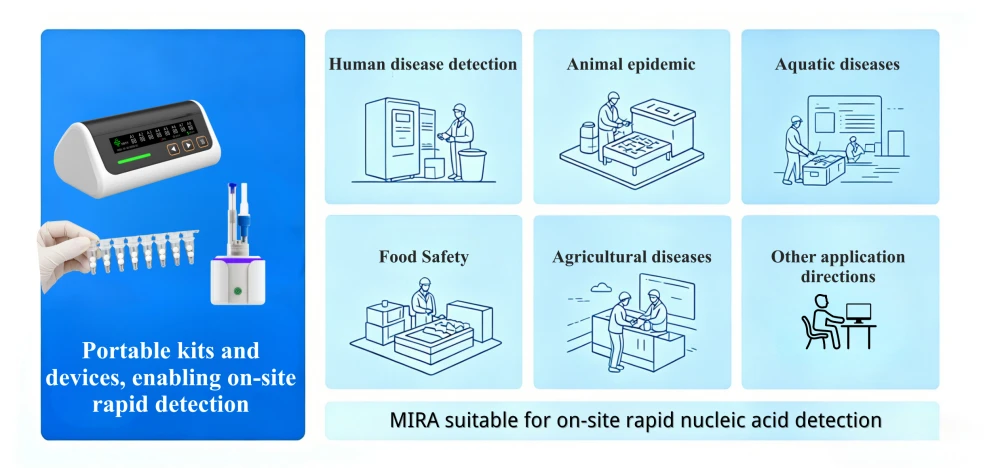
4. Market Application: Diverse Scenarios, Strong Field Deployability
PCR: Primarily used for precise laboratory testing and is not well suited for on-site rapid detection. High equipment costs and lack of portability limit its use in grassroots and field settings.
LAMP: Can be used for some on-site detection, but on-site rapid testing demands "results in minutes" – a speed advantage LAMP does not offer. Opening the tube in the field also poses a high risk of environmental contamination.
MIRA: With its advantages of speed, portability, and simplicity, users can carry compact instruments and lyophilized reagents directly to the front line. It is widely used in human medical diagnostics, animal disease detection, aquaculture, food safety, agricultural and forestry testing, and many other fields – demonstrating far greater field applicability than competing technologies.

5. Scientific Publication: High-Quality Data, Strong Recognition
PCR: Although widely used, the technology is mature with limited room for innovation, making it difficult to publish in high-impact journals. Experimental reproducibility is often affected by equipment and operator variability, resulting in moderate data stability.
LAMP: Research interest remains high, but primer design and specificity issues can undermine the persuasiveness of the data, affecting journal acceptance rates.
MIRA: MIRA technology is highly versatile and can be combined with CRISPR, microfluidics, sequencing, and other techniques, offering strong research innovation. It achieves a detection sensitivity of 1–5 copies/μL with excellent specificity and reliable data, making it a hot topic in the field of molecular detection.
Amp-future Biotech's MIRA technology, with its core strengths of accuracy, reliability, speed, and simplicity, breaks the stereotype that nucleic acid amplification can only be performed in a laboratory. Whether used in laboratory research or frontline applications, MIRA consistently demonstrates flexibility and reliability.

