


Aeromonas hydrophila is a significant pathogenic bacterium in aquaculture, causing severe diseases in farmed animals and resulting in substantial economic losses. To enable rapid on-site detection, we developed a portable microfluidic platform that integrates multi-enzyme isothermal rapid amplification (MIRA) with automated fluid handling. The chip design incorporated a miniature vibration motor and ceramic heating pads to maintain
precise temperature control and ensure reaction homogeneity throughout nucleic acid extraction and amplification. A miniature air pump drove the crude DNA extract through the chip in a single pipetting step for accurate quantification. The extracted DNA was subsequently transferred to a reaction chamber preloaded with MIRA reagents for isothermal amplification at 39℃ under real-time fluorescence monitoring. This platform detected
A. hydrophila in water samples within 40 min, achieving a linear range from 1 × 10² to 1 × 10⁷ CFU⋅mL−1 and a limit of detection (LOD) of 10 CFU⋅mL−1. Notably, its modular design allows easy interchange of primers and probes, making the platform readily adaptable for detecting diverse bacterial pathogens in aquaculture.
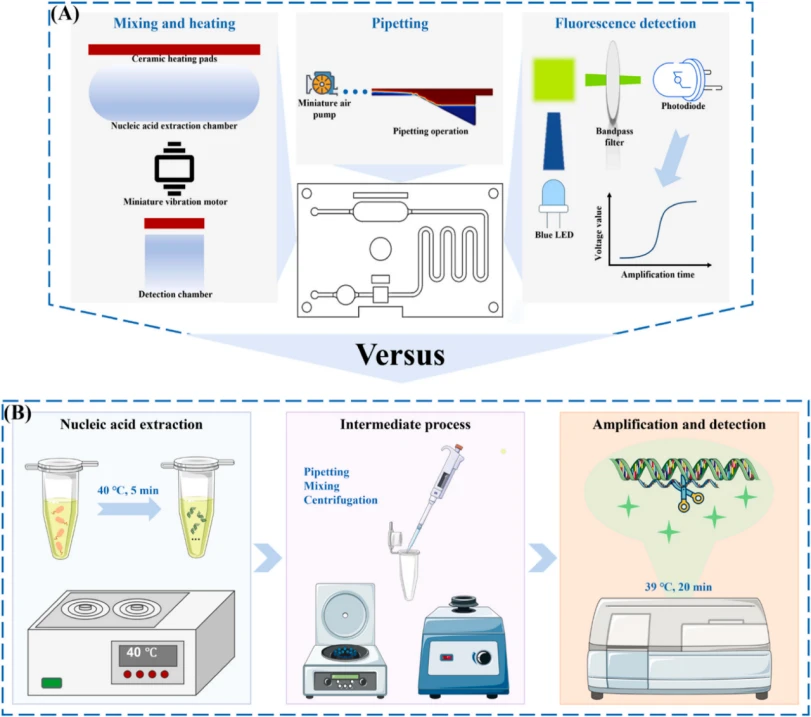
Schematic comparison of the portable microfluidic platform and the conventional detection platform for A. hydrophila. (A) The portable microfluidic
platform. The detection workflow on this platform integrates nucleic acid extraction, precise pipetting, amplification, and detection. (B) The conventional detection platform. The conventional laboratory-based workflow relies on sophisticated equipment, trained personnel, and time-intensive procedures.
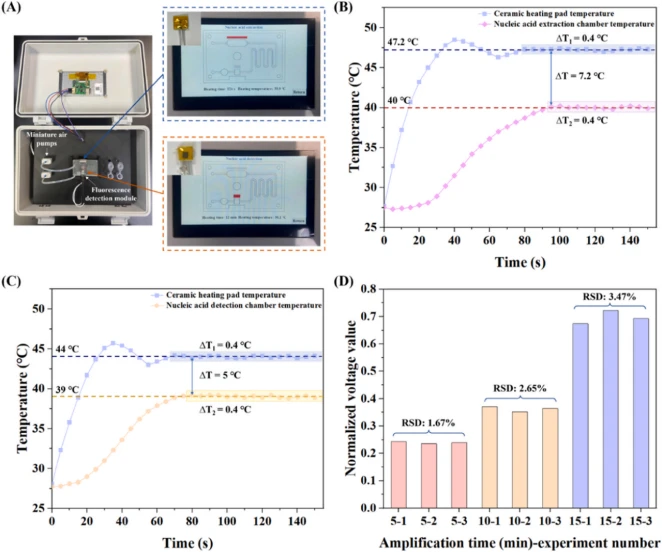
Stability assessment of the portable microfluidic platform. (A) Photograph of the portable microfluidic platform. (B, C) Thermal performance of the nucleic acid extraction and detection chambers. Relationship between ceramic heating pad and chamber temperature. (D) Fluorescence detection stability (N = 3). Fluorescence intensity was measured at 5-minute intervals throughout the amplification process.
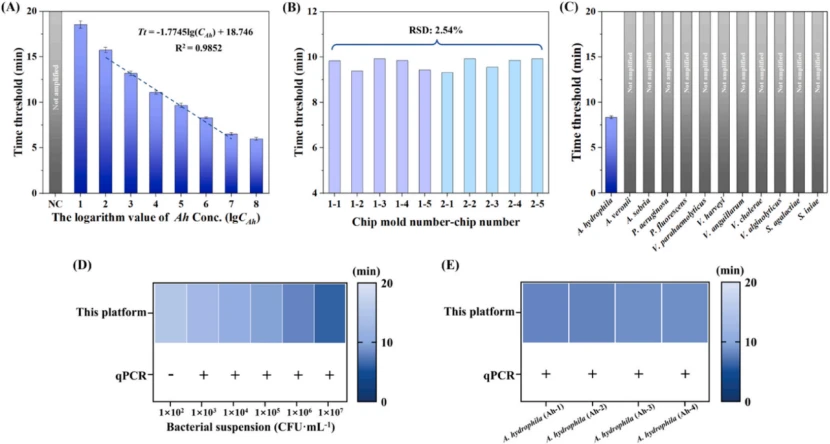
Performance evaluation of the portable microfluidic platform. (A) Calibration curve for A. hydrophila detection (N = 3). A calibration curve was established by detecting A. hydrophila across a concentration range of 1 × 101 –1 × 10⁸ CFU⋅mL−1 under optimal conditions. (B) Chip-to-chip reproducibility assessment. The MIRA assay for A. hydrophila was performed on ten chips fabricated from each of two independent molds. (C) Specificity analysis (N = 3). The MIRA assay's specificity was validated against the target A. hydrophila and 11 non-target bacterial species. (D) Comparison with qPCR (N = 3). Both the platform and qPCR were used to detect A. hydrophila at various concentrations. (E) Detection of field-isolated strains (N = 3). Four field-isolated strains of A. hydrophila were detected using both the platform and qPCR.